El Salvador Flag: Quick Facts
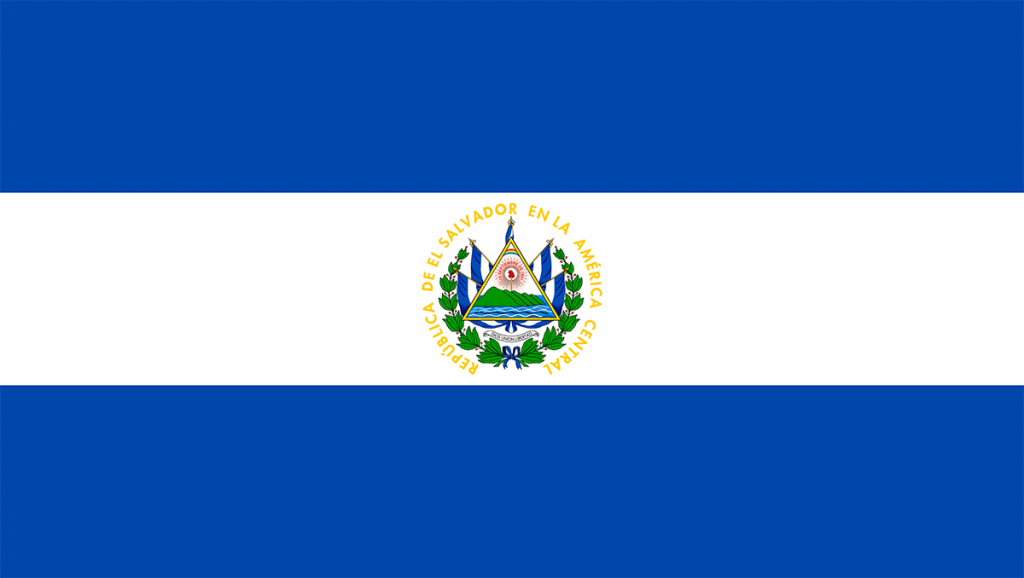
Official name: ‘Bandera Magna’ – Great Flag.
Nickname: ‘Tierra de Volcanes Soberbios’ – Land of Superb Volcanoes.
Adopted: 1912 (modern design), last modified 1972.
Meaning: The El Salvador flag is a reflection of the national motto “God, Union, Liberty”.
Symbol: The coat of arms symbolizes independence from Spain in 1821.
Colors: Blue and white colors represent the country and its people. The two blue stripes represent the ocean and sky, the white represents peace.
Visitors to El Salvador are often rightly curious about the national flag as it is packed with history and meaning. There are good reasons it is very similar to the national flags of both Nicaragua and Honduras…
The El Salvador flag, ‘Bandera Magna’, the ‘Great Flag’, is also known as ‘Tierra de Volcanes Soberbios’, meaning “Land of Superb Volcanoes”. That’s because El Salvador has 170 volcanoes within its borders and lies in the Pacific ‘Ring of Fire’, which is one of the areas with the most seismic and volcanic activity in the world.
Table of Contents
The History Of The Flag Of El Salvador
The flag of El Salvador you see today went through significant evolution before it was last modified in 1972. Perhaps El Salvador is finally at peace with its national identity?
Flags Before The Country Was Formed
In 1535, the flag flown in the geographic region now known as El Salvador was the burgundy cross of the Viceroy of New Spain as the Spanish Empire controlled the area.
In 1821 the land mass that later became known as El Salvador became part of the First Mexican Empire. The Mexican Empire’s flag was, and still is, a green, white and red vertical tricolor with a coat of arms of Mexico at the center.
Origins Of The Modern El Salvador Flag
The origins of the modern flag design arose during the time of the Napoleonic Wars in Europe when Spanish colonies of the New World began to seek their own independence.
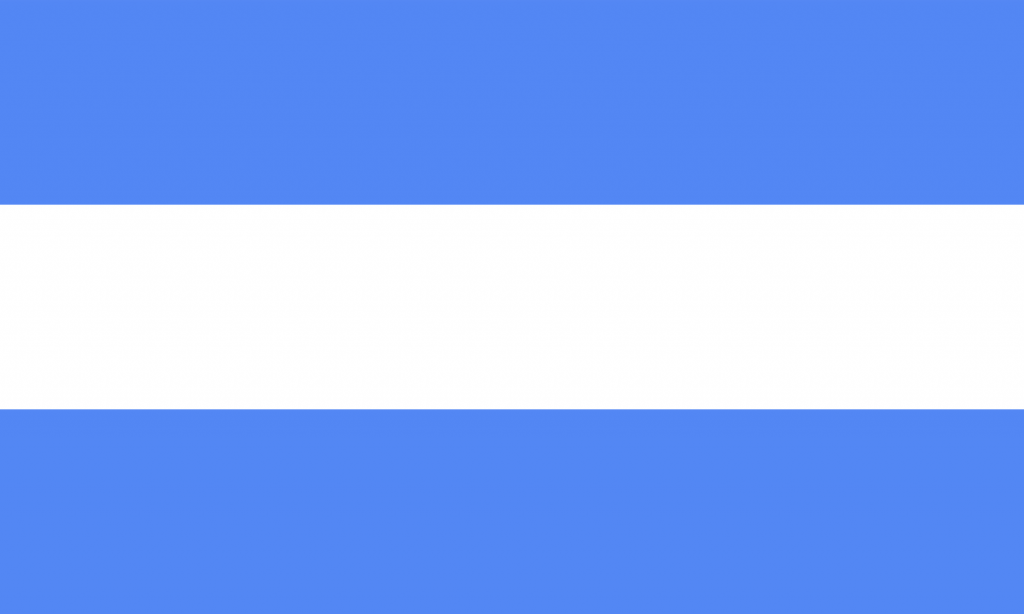
The United Provinces of the Río de la Plata, today known as Argentina, were the first to proclaim their sovereignty under a horizontal tricolor of a blue-white-blue flag.
That ‘liberation flag’ was then briefly flown in the Caribbean in 1818 by the privateer Luís Aury, and it was a source of inspiration to Spanish subjects in the area who were seeking their freedom.
Later, when the independence of Central America was eventually proclaimed in 1822, the liberation flag became the national flag of the United Provinces of Central America which later split into five separate countries. These five countries became Guatemala, Honduras, El Salvador, Costa Rica, and Nicaragua and you can see how their borders relate on this post about the map of El Salvador.
El Salvador officially became a country in 1824 and used the same triband liberation flag until it was later abandoned in 1865.
The Stars And Stripes El Salvador Flag
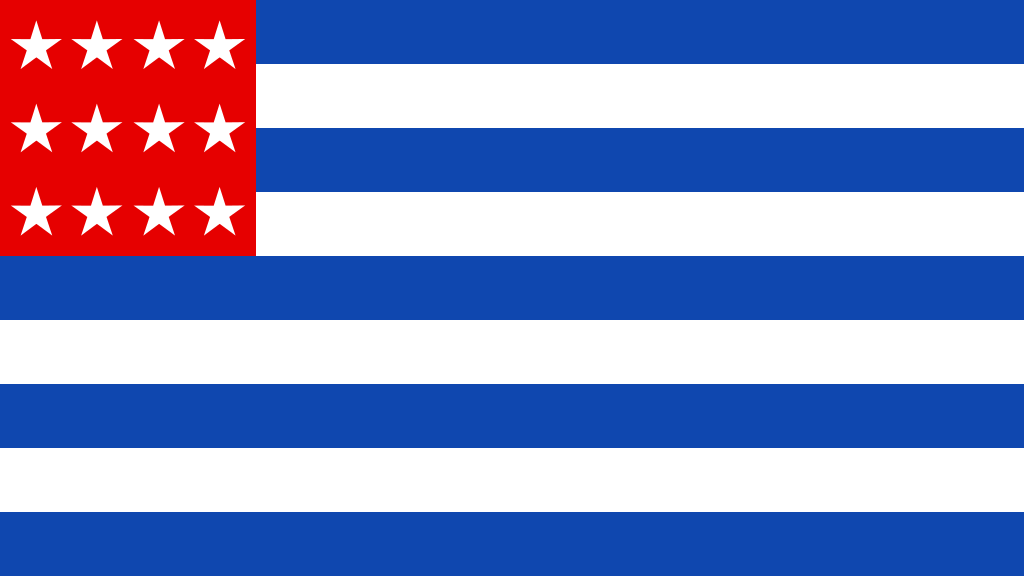
As El Salvador started to establish its own identity as a nation, it dropped the liberation flag in favor of a flag that resembled the Stars and Stripes of the United States.
This version of El Salvador’s national flag was much more complex and adopted red into the color scheme. Originally, it featured nine alternating blue and white stripes with a red box and nine white stars in the top left corner.
The stars represented the provinces united under the flag.
As new provinces (departments) were recognized, a new star was added to the flag. This led to an additional five stars being added to the flag of El Salvador flag bringing the total to 14 in 1875. For a list of El Salvador’s 14 departments, see the political map of El Salvador.
This flag lasted for some 40 years and was unique because it featured another side with a coat of arms.
The Return Of The Horizontal Triband Flag Design
In 1896 El Salvador joined with Nicaragua and Honduras to create the Greater Republic of Central America and later in 1912 a slightly modified version of the original flag of El Salvador was reintroduced that was similar to the flag of the Great Republic of Central America.
A civil flag without the national coat of arms was also adopted by El Salvador at this time.
The national flag saw slight modifications between 1916 and 1972 before arriving at the modern-day flag of El Salvador you see below.
El Salvador Flag FAQs
What Does The El Salvador Flag Look Like?
The El Salvador flag consists of three horizontal stripes: blue, white, and blue. The national coat of arms appears in the center of the white stripe.
Why Does The El Salvador Flag Look Like Other Central American flags?
It looks broadly similar in design to the flags of Honduras and Nicaragua because the blue-and-white tri-band design of the United Provinces of Central America flag influenced several modern national flags when Central America split into five separate countries in 1822.
What Does The El Salvador Flag Mean?
The El Salvador flag is a reflection of the national motto “God, Union, Liberty” and symbolizes independence.
What Do The Colors Mean?
The colors and symbols on the flag are designed to represent the country and its people.
Originally, the design with two blue horizontal stripes represented freedom from colonial rule in the area, but in the modern flag of El Salvador, the two blue stripes have more meaning and are said to represent the ocean and sky. The central white stripe is said to symbolize peace.
Blue is also an important color in Salvadoran culture and identity due to the country’s cultivation of indigo.
Why Is The El Salvador Flag Blue And White?
Blue and white were the colors of the liberation flag, which was originally used when El Salvador officially became a country in 1824.
What Is Written On The El Salvador flag?
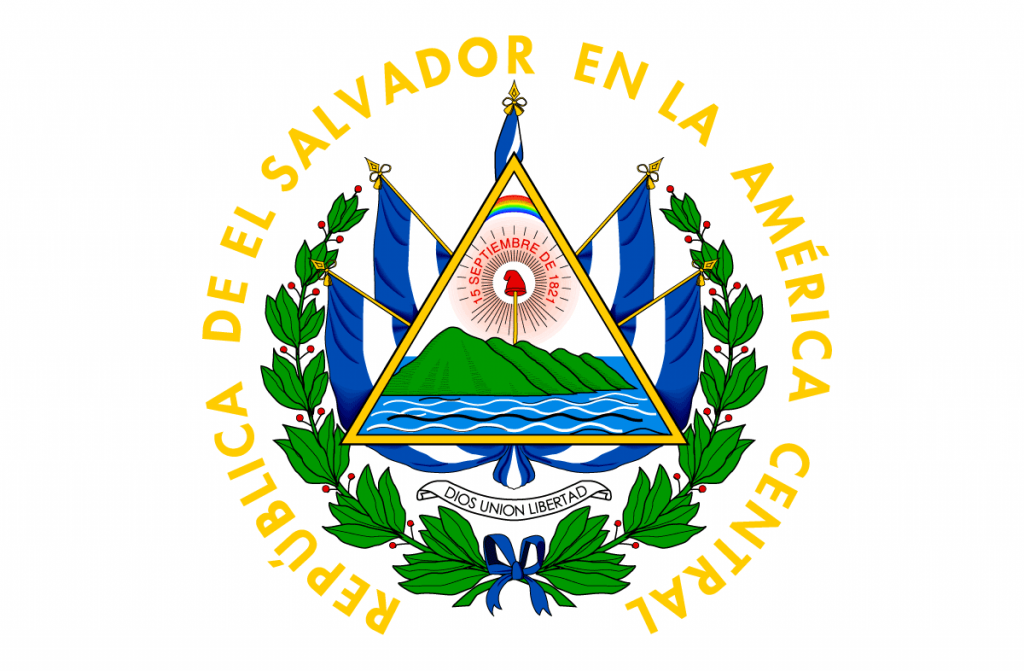
The words on the national flag “REPUBLICA DE EL SALVADOR EN LA AMERICA CENTRAL” declare in Spanish the ‘Republic of El Salvador in Central America’. The date of independence ’15 September 1821′ is also written along the national motto “God, Union, Liberty”.
When Was The El Salvador Flag Adopted?
The National flag of El Salvador has gone through several variations since El Salvador became a country in 1824. Originally, a simple triband liberation flag was used with lighter blue horizontal lines, then a Stars and Stripes version of the El Salvador Flag was used for 40 years in the 1800s, before the modern-day national flag was adopted in 1912.
El Salvador Flag Coat Of Arms: An In-Depth Guide
The Coat of Arms in the middle of the El Salvador flag starts with the words: “REPUBLICA DE EL SALVADOR EN LA AMERICA CENTRAL” in a circle on the outside. These words declare in Spanish that it’s the ‘Republic of El Salvador in Central America’.
Inside this, there is a green laurel wreath tied into 14 different parts, which represents solidarity, and symbolizes the 14 departments (administrative provinces) of the country. There is also a paper scroll with the national motto of El Salvador ‘God, Union, Liberty’ written on it as well as ’15 September 1821′, which is the date when El Salvador gained its independence from Spain.
Inside there are five raised flags representing the flags of the Federal Republic of Central America, which surround a yellow bordered triangle.
This triangle represents the three branches of El Salvador’s government. Inside the triangle, five green volcanoes rise out of the blue ocean.
These five volcanoes in the center of the triangle represent the five member states of the United Provinces of Central America (many of which use blue and white colors on their flags as a Pan-Central American symbol).
Finally, a rainbow arch sits at the top of the triangle to finish off the nation’s coat.
Above the volcanoes, there is a red cap on a staff that’s based on the soft caps once worn by freed slaves in Ancient Rome. It’s a red canton cap of liberty, which is also known as a red Phrygian cap. The canton cap is a soft triangular hat that came to symbolize republican independence in Europe.
Why Blue Is An Important National Color In El Salvador
During El Salvador’s history, the national flag has been several different shades of blue. These blues range from light to dark and have included the shades Klein Blue, Royal blue, Sapphire, and Indigo. The modern flag is Cobalt Blue.
Before it was featured on El Salvador’s flag, blue was already an important color in Salvadoran culture and identity. Native American cultures of Mesoamerica produced the indigo plant from which they used extracts to produce blue dyes.
When the Spanish colonized the area, they were amazed at how much indigo grew naturally and referred to it as “blue gold”. They then set about turning El Salvador into one of the world’s foremost providers of indigo before it was later almost completely replaced by coffee cultivation.
Today, indigo still grows in the wild and El Salvador is one of the few countries in the world that still cultivates indigo to produce blue dyes.